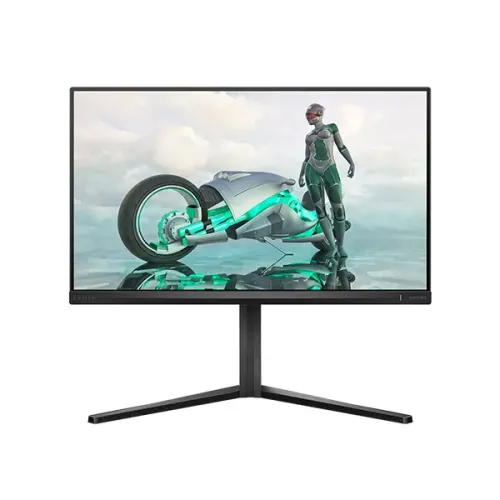
Philips Evnia 25M2N3200/69 24.5-inch 180Hz Full HD IPS Gaming Monitor
Exact model and regional code
The Philips Evnia 25M2N3200 is a 24.5-inch viewable Full HD gaming monitor sold in Bangladesh as a 25-inch-class model. The official Asia-Pacific regional product code that matches this catalog unit is 25M2N3200/69. The slash suffix matters: Philips uses closely related names for different panel and stand revisions, including the 25M2N3200W 240Hz VA model, the 25M2N3200L tilt-only stand version and the faster 25M2N3200U. This product’s catalog photos show the full-height SmartErgoBase column, V-shaped base, headset hook and cable clip, which match the /69 regional configuration. The official specification lists an IPS panel, 180Hz maximum refresh and ergonomic adjustment. We retain the catalog product name, ID, slug, active status, Monitors category, active variant, SKU, ৳24,100 price and all four image IDs and URLs. The generic “Others” brand and padded model fields are corrected to Philips, Evnia 25M2N3200 and 25M2N3200/69.
24.5-inch Full HD IPS panel
The display uses a flat Fast IPS LCD with a W-LED backlight. Its actual diagonal viewing size is 24.5 inches (62.2 cm), conventionally marketed as a 25-inch monitor. Native resolution is 1920 × 1080 Full HD in a 16:9 aspect ratio, with a pixel density of 89.91 pixels per inch and 0.2832 × 0.2802 mm pixel pitch. At this size, Full HD is a familiar choice for competitive games and keeps graphics workloads manageable; text and fine details are less dense than on a QHD display. Philips specifies a 543.744 × 302.62 mm effective viewing area, 178° horizontal and vertical viewing angles, 16.7 million colors (8-bit), and an anti-glare coating rated 3H with 25% haze.
180Hz refresh and input compatibility
The maximum refresh rate is 180Hz at 1920 × 1080. This is the specified operating maximum and does not require a separate overclock setting. The monitor has two HDMI 2.0 inputs and one DisplayPort 1.4 input; each can carry a 1080p high-refresh PC signal. A PlayStation 5 or Xbox Series X|S typically uses up to 1080p at 120Hz over HDMI, depending on the game and console output mode. The HDMI and DisplayPort inputs support AMD FreeSync / Adaptive-Sync. Philips also identifies the display as NVIDIA G-SYNC Compatible; use DisplayPort with a compatible NVIDIA GeForce GPU for that mode. Actual available modes depend on GPU, cable, driver and operating system settings.
Response time and motion clarity
Philips lists 1ms gray-to-gray response time through SmartResponse. The separate Smart MBR feature uses backlight strobing and is described in regional materials as approximately 0.5ms or 1ms MPRT. MPRT and GtG measure different things and should not be presented as interchangeable. Motion blur reduction strobes the backlight, can reduce perceived brightness and cannot be used together with Adaptive-Sync; when Smart MBR is active, manual brightness adjustment may be locked. The monitor also supports HDR10 signal input, but it has a conventional edge-lit W-LED IPS backlight and no local dimming or VESA DisplayHDR certification. HDR10 compatibility is therefore basic signal/tone-map support, not a claim of high-end HDR contrast or brightness.
Brightness, contrast, colour and HDR
Brightness is the main specification conflict. Philips’ official 25M2N3200/69 datasheet states 300 cd/m² typical. Several Bangladesh listings, including Star Tech, show 250 cd/m², while other regional sheets and sellers show 300 cd/m². A separate /93 regional sheet also lists 250 cd/m². Because the catalog unit suffix /69 matches the 300-nit official Asia-Pacific sheet, the product attributes state the manufacturer’s 300-nit figure and disclose the 250-nit Bangladesh retailer listing. Confirm the rating on the box or with the seller if brightness is purchase-critical. Typical static contrast is 1000:1. Philips’ SmartContrast “Mega Infinity DCR” is dynamic image processing and should not be confused with native static contrast. Philips and retailers report wide color gamut values that vary by measurement basis and source; the regional sheet lists 122% sRGB, 93.5% DCI-P3, 104% NTSC and 103% Adobe RGB. Gamut coverage is not a per-unit calibration certificate.
Eye comfort and image controls
For eye comfort and image control, Philips lists Flicker-Free and LowBlue Mode. EasyRead and sRGB modes are available, alongside SmartImage Game presets. Gaming presets include FPS, Racing and RTS adjustments; the RTS mode includes SmartFrame area highlighting. These modes change the picture profile and do not guarantee a particular result for every game or room. The rear EasySelect control gives access to the on-screen display. The monitor has no built-in speakers and no USB hub. Its single 3.5mm connector is audio out: it passes audio received through HDMI or DisplayPort to headphones or external speakers. The source table heading “Audio (In/Out)” caused an incorrect catalog value; it is not an audio input or microphone jack.
Video and audio connections
The regional /69 bundle includes two HDMI 2.0 ports, one DisplayPort 1.4 input and one 3.5mm headphone/audio output. HDCP 1.4 and HDCP 2.2 are supported over HDMI and DisplayPort. There are no USB-C, USB-A, VGA or DVI ports. Check that a PC has a compatible graphics output and use a suitable cable for 180Hz. The package may include HDMI and DisplayPort cables, a power cable and documentation; accessory bundles can vary by local distributor, so confirm what the seller will supply before ordering.
SmartErgoBase, mounting and dimensions
The included Philips SmartErgoBase is a key benefit of this version. It provides 130mm of height adjustment, ±30° swivel, ±90° pivot and approximately −5° to +20° tilt. All four product images show the adjustable column and its cable-routing clip, including the side profile and the rear mounting area. The rear has a standard 100 × 100 mm VESA pattern and a Kensington lock slot. Philips rates the assembled monitor at about 557 × 508 × 239 mm at maximum stand height and 4.55 kg; without its stand it is about 557 × 331 × 64 mm and 3.30 kg. The shipping carton is about 730 × 420 × 188 mm and 7.54 kg. Height and dimensions can change slightly with stand position, so allow room behind the desk for its base and cabling.
Power and package contents
Power is supplied internally, so this monitor does not need an external adapter brick. The input rating is 100–240V AC, 50–60Hz. Philips lists 19.1W typical on-mode consumption, 0.5W in standby and 0.3W when off. The power indicator is white during operation and blinks white in standby. This is useful information for desk planning, but consumption varies with brightness, picture mode and connected signal.
Bangladesh price and warranty
Bangladesh seller pages advertise a three-year warranty; retain the invoice and confirm the warranty provider, regional serial eligibility and claim process with the seller. The observed November 2026 listing prices vary by shop and page refresh: Star Tech, Skyland, Ryans and TechLand price points are roughly ৳23,800–৳24,100 in the reviewed research, while regular prices are higher. BiponiBD’s current ৳24,100 variant price is preserved. The vendor’s live offer and stock can change, so the catalog should display its own current price and warranty terms rather than implying that other shop offers are guaranteed.
Best use cases and model comparisons
The Evnia 25M2N3200/69 suits a PC gamer who wants a compact 24.5-inch Full HD screen, 180Hz refresh, IPS viewing angles and an adjustable stand. Its FreeSync and G-SYNC-compatible support can help match refresh to frame rate when the graphics card and connection are configured correctly. It can also serve for general desktop use, study and entertainment. Buyers wanting a larger 27-inch image should compare the distinct 27M2N series; buyers seeking deeper native contrast should consider a VA panel, while buyers wanting HDR with local dimming should select a suitably certified display.
Limitations buyers should know
Key trade-offs are the 1920 × 1080 resolution, modest 1000:1 static contrast, the 250/300-nit source variation and the lack of built-in speakers or USB-C charging. HDR10 input support does not make this a DisplayHDR-class screen. The 180Hz maximum also requires a compatible source and correct display settings. The package is not a laptop dock: there are no USB data ports or power delivery. With these limits made clear, the official /69 specification and the supplied images point to a coherent 180Hz IPS monitor with a genuinely ergonomic stand, rather than the visually similar tilt-only or 240Hz VA variants.